🛡️ Discreet & Fast Shipping — Your Privacy & Safety, Guaranteed
Turkey tail (Trametes versicolor) is a medicinal mushroom commonly found in extracts, powders, and other dietary supplements. However, determining an appropriate turkey tail dosage can be confusing because consumer supplements and clinical research often use very different preparations and amounts.
For general wellness products, labels may list amounts ranging from hundreds of milligrams to several grams per serving. Clinical research involving compounds such as PSK and PSP has also examined higher amounts, particularly in oncology settings under professional supervision.
Those differences matter. A quantity studied in a clinical trial should not automatically become a recommended daily amount for healthy adults.
This guide explains the dosage ranges discussed in the source material, how extract and powder amounts differ, what clinical research can—and cannot—tell us, and which safety considerations deserve attention.
TL;DR
- Turkey tail products vary considerably in concentration, extraction method, and serving size.
- Consumer supplement amounts can differ substantially from doses studied in clinical research.
- PSK and PSP have been studied in cancer-care settings under medical supervision and should not be treated as ordinary wellness supplements.
- People receiving cancer treatment or taking medications that affect the immune system or blood clotting should speak with a healthcare professional before using turkey tail.
- Product labels, extraction methods, and third-party testing can help consumers compare supplements more carefully.
Turkey Tail Dosage by Goal: Immunity, Gut Health, and More
There is no single turkey tail dosage that applies to every product or every person. The amount listed on a supplement label depends on the form of the mushroom, extraction method, concentration, and intended use.
The source material describes consumer amounts in broad ranges, including standardized extracts and whole mushroom powders. However, these figures should be viewed as information about commonly discussed supplement amounts rather than a universal prescription.
For example, the draft describes general wellness products using amounts in the range of 500 to 1,500 milligrams of extract or approximately 1 to 2 grams of whole powder per day. It also discusses larger amounts associated with clinical preparations such as PSK and PSP.
The important distinction is the preparation itself. A gram of whole mushroom powder does not necessarily provide the same concentration of compounds as a gram of a standardized extract.
Why Product Form Matters
Turkey tail supplements commonly appear as:
- Whole mushroom powder
- Hot water extracts
- Dual extracts
- Capsules
- Liquid extracts
Extraction can change the concentration and composition of the resulting product. Consequently, comparing two supplements solely by the number of milligrams on the front label can be misleading.
A 500-milligram extract and 500 milligrams of whole mushroom powder may not have the same concentration of compounds.
Always check the Supplement Facts panel, serving size, extraction information, and standardization details before comparing products.
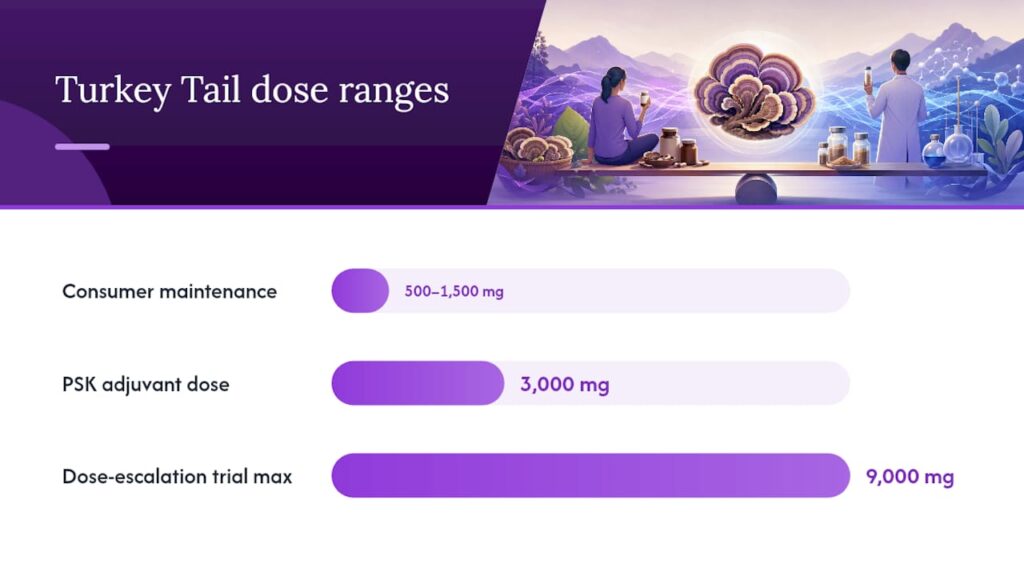
500–1,500 mg: Turkey Tail Dosage for Consumers vs Clinical PSK
What Does Clinical Research Show About Turkey Tail?
Much of the higher-dose research involving turkey tail has focused on cancer care rather than general wellness.
Clinical research has examined compounds such as PSK, or polysaccharide-K, and PSP, a related polysaccharopeptide. These preparations differ from many ordinary mushroom supplements sold for general consumer use.
The source material highlights research involving cancer patients and notes that some studies have examined several grams per day under medical supervision. One phase 1 study involving women with breast cancer investigated a Trametes versicolor preparation at doses considerably higher than typical consumer supplement amounts.
That finding does not mean healthy adults should reproduce the study dosage.
Clinical trials involve specific formulations, patient populations, monitoring procedures, and treatment goals. Researchers also control factors such as product quality and study conditions. Those circumstances differ considerably from taking an over-the-counter supplement at home.
PSK and PSP Are Not the Same as Ordinary Turkey Tail Powder
PSK and PSP have received attention because researchers have studied their potential role alongside conventional cancer treatment.
Historical research has examined PSK at amounts around several grams per day. The source material also describes clinical preparations as standardized products used in supervised settings.
These details provide useful research context, but they should not be interpreted as instructions for self-treatment.
Turkey tail supplements cannot replace chemotherapy, radiation, surgery, immunotherapy, or other cancer treatments prescribed by a medical team.
Turkey Tail Side Effects and Safety
Turkey tail appears to be tolerated by many people, but that does not make every product or dosage appropriate for everyone.
Digestive effects can occur, particularly when someone starts a new mushroom supplement. The source material identifies concerns such as diarrhea and changes in stool appearance.
If you develop persistent or severe digestive problems after starting a supplement, stop using it and speak with a healthcare professional.
Who Should Talk to a Doctor First?
Professional guidance becomes particularly important if you:
- Receive chemotherapy, radiation, or immunotherapy.
- Take immunosuppressant medication.
- Use anticoagulant or antiplatelet medication.
- Have an autoimmune condition.
- Are pregnant or breastfeeding.
- Take several prescription medications or manage a complex medical condition.
The reason is simple: supplements can interact with medications or affect biological pathways relevant to treatment.
Anyone undergoing cancer treatment should tell their healthcare team about every supplement they use. This gives clinicians a clearer picture of potential interactions and allows them to make informed decisions about the overall treatment plan.
How Should You Read a Turkey Tail Supplement Label?
The number printed on the front of a bottle tells only part of the story.
Before choosing a turkey tail supplement, examine the full label. Pay attention to the mushroom form, serving size, extraction method, and testing information.
Useful details include:
- Amount per serving: Check how many milligrams the manufacturer considers one serving.
- Extraction method: Look for information about hot water, dual extraction, or another process.
- Standardization: Some products provide information about beta-glucans or polysaccharides.
- Ingredient list: Check for unnecessary fillers or additives.
- Third-party testing: Independent testing can provide additional information about identity, contaminants, or potency.
- Mushroom material: Determine whether the product contains fruiting body, mycelium, or another preparation.
A transparent label makes it easier to understand what you are actually purchasing.
Turkey Tail Extract vs. Powder
Extracts and powders should not be compared solely by weight.
Whole mushroom powder contains the ground mushroom material. Extracts undergo additional processing designed to concentrate particular compounds. As a result, a smaller quantity of extract can contain a different concentration of compounds than a larger amount of powder.
The source article notes that extraction ratios can also create confusion. For example, a product may describe a 10:1 extraction ratio, indicating that a larger amount of raw mushroom material went into producing a smaller quantity of extract.
However, an extraction ratio does not automatically tell you the final potency or biological effect.
For that reason, consumers should look beyond the ratio and examine the manufacturer’s information about extraction, standardization, and testing.
What About Taking Turkey Tail With Food?
Some people choose to take mushroom supplements with food because doing so may reduce the chance of stomach discomfort.
The source material also discusses dividing a daily serving rather than taking everything at once. However, the best approach depends on the specific product, its label instructions, and individual tolerance.
Rather than assuming that one schedule works for everyone, follow the manufacturer’s directions and seek professional advice when medications or medical conditions are involved.
How Long Does Turkey Tail Take to Work?
There is no reliable timeline that guarantees when someone will notice an effect from turkey tail.
The source material describes immune and gut-related effects as gradual and discusses several weeks of consistent use.
However, individual experiences can vary significantly. A person’s diet, health status, medications, supplement formulation, and other factors may influence their experience.
Avoid treating a specific number of weeks as a promise of results.
What Does the Research Actually Tell Us?
Research can provide useful context, but it does not answer every consumer question.
Clinical studies may investigate a specific extract, a specific population, and a specific health outcome. A supplement sold to consumers can have a different composition, extraction process, and concentration.
Therefore, it is important to separate three different ideas:
1. What researchers studied
This includes specific turkey tail preparations such as PSK or PSP.
2. What supplement labels contain
Consumer products can vary significantly in composition and standardization.
3. What someone personally needs
That depends on individual health circumstances and cannot be determined from a general article alone.
Keeping these categories separate helps prevent clinical research from being turned into misleading dosage claims.
Can Turkey Tail Treat Cancer?
Turkey tail has attracted significant research interest in oncology, particularly because compounds such as PSK and PSP have been studied alongside conventional cancer treatments.
However, research into a mushroom extract does not mean that ordinary turkey tail supplements can independently treat cancer.
Anyone with cancer should follow the treatment plan provided by their oncology team. If they are considering turkey tail as a complementary supplement, they should discuss it with their healthcare professionals first.
This distinction is especially important because supplements can interact with medications or treatment pathways.
Choosing a Turkey Tail Supplement
If you decide to explore turkey tail as a dietary supplement, product quality deserves attention.
Look for clear information about:
- The mushroom species
- The mushroom material used
- Extraction method
- Serving size
- Beta-glucan or polysaccharide information
- Third-party testing
- Potential contaminants
- Full ingredient list
- Manufacturer information
Avoid products that rely heavily on vague proprietary blends while providing little information about what the serving actually contains.
A transparent label does not guarantee that a supplement will produce a particular health benefit. It does, however, give consumers more information with which to evaluate the product.
The Bottom Line on Turkey Tail Dosage
Turkey tail dosage can look straightforward on a supplement label, but the underlying science is more complicated.
Consumer products can contain whole mushroom powder or concentrated extracts, while clinical research may use specialized preparations such as PSK or PSP. Those products should not automatically be treated as interchangeable.
The source material discusses consumer ranges around hundreds of milligrams to several grams, while clinical research has investigated considerably higher amounts in supervised settings.
The safest approach is to evaluate the specific product, follow its labeling, and consider your personal health circumstances. If you take prescription medication, have an autoimmune condition, are pregnant or breastfeeding, or are receiving cancer treatment, consult a healthcare professional before adding turkey tail to your routine.
Frequently Asked Questions
How much turkey tail should I take per day?
There is no universal amount that applies to every turkey tail product. Extracts and whole powders can differ substantially in concentration, so the serving instructions and product specifications matter.
What is the difference between turkey tail powder and extract?
Powder generally contains ground mushroom material, while an extract undergoes processing designed to concentrate certain compounds. Therefore, equal weights of powder and extract should not automatically be considered equivalent.
What is PSK?
PSK, or polysaccharide-K, is a compound derived from turkey tail that has been studied extensively in clinical research, particularly in oncology settings.
Can I take turkey tail during chemotherapy?
Do not add turkey tail to a cancer treatment plan without first speaking with your oncology team. Supplements may interact with medications or affect biological pathways relevant to treatment.
Are turkey tail supplements safe?
Many people tolerate turkey tail supplements, but side effects and interactions can occur. Your individual health situation, medications, and the specific product all matter when assessing safety.
How long does turkey tail take to work?
There is no guaranteed timeline. Some effects discussed in the source material may develop gradually over several weeks, but individual responses can vary.
Important Note
This article provides general educational information about turkey tail supplements and dosage research. It is not a substitute for individualized medical advice. Speak with a qualified healthcare professional before using turkey tail if you have a medical condition, take prescription medication, are pregnant or breastfeeding, or are receiving cancer treatment.